
Seeing Behavior Through Trajectory-Based Observation

Welcome to Field Notes, a bi-weekly collection of observations from our team at Image Sensing Systems.
We spend a lot of time watching how people move through real streets. When you observe enough locations for long enough, certain patterns become impossible to ignore. Subtle behaviors start to repeat, revealing how people actually negotiate space with one another in ways that are easy to miss unless you’re there to watch movement unfold over time.
Field Notes exists to share those observations. These are the moments and movement patterns that stand out as we study real-world locations. We offer them in case they’re useful in your own work. If they help clarify something you’ve noticed or surface a detail you hadn’t considered, then they’ve done their job.
Here is what caught our attention this week.
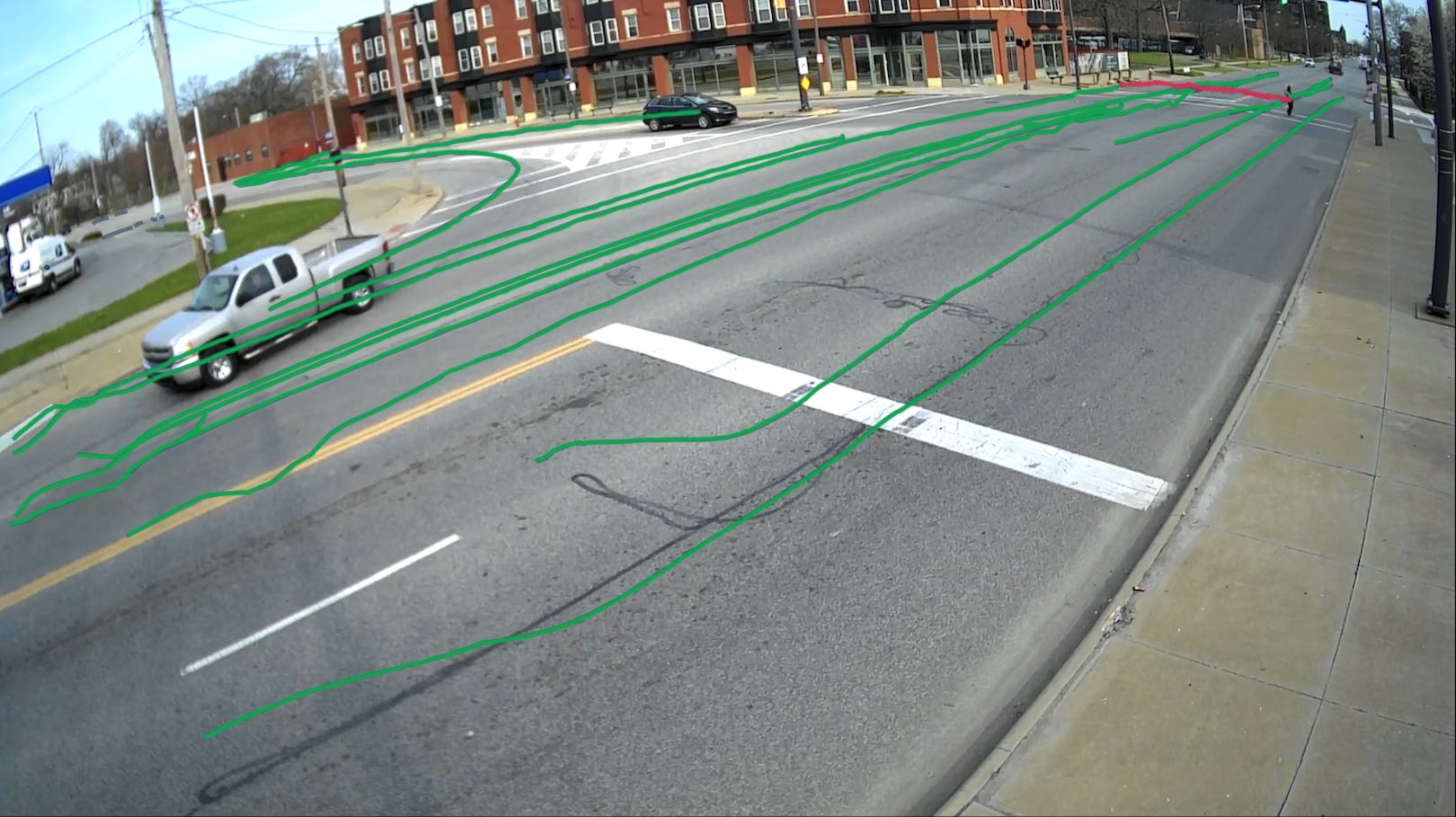
If you stand at an intersection long enough, you start to notice the same things happening over and over. Drivers roll through a right turn because they believe they can clear the movement before a pedestrian enters the crosswalk. Pedestrians cross outside of marked crossings where they feel they can manage risk more predictably. Drivers speed up approaching a signal because they believe they can make the light if they accelerate.
These moments are easy to dismiss as noise. But when they repeat over time at the same location, they stop being random and start being diagnostic.
Most traditional traffic data captures outcomes at a point. It tells you how many people passed, how fast they were moving, or whether they complied at a specific location. That information is useful, but it compresses behavior into a single moment. What it often misses is how people approached the situation, how conditions shaped their decisions, and where things began to break down before a conflict was ever visible.
By observing complete movement paths over space and time, the payoff is straightforward. You can see where conflicts form, how people interact, and where behavior consistently breaks down. When those patterns repeat day after day at the same location, they point to something structural rather than something random. That’s the difference between documenting a problem and understanding it.
In many cases, the effort required to collect this kind of movement data is no greater than the effort already spent deploying tube counters or collecting video for traditional counts. The difference is in what you get back. Instead of only knowing how many vehicles or pedestrians passed a point, you can see how movements unfolded and how decisions were made. Movement data supports explanation, not just documentation.
This first edition is intentionally simple. It introduces a lens we think is genuinely useful: by using the same data-collection approaches many agencies and consultants already rely on, it’s possible to move beyond describing conditions and start understanding them.
Field Notes is designed to build progressively. Each edition will add another layer, using concrete field examples to show how this lens can be applied in practice. Our goal is simply to share what we’ve learned. This kind of insight only has value if people know it exists and understand how to use it.
In the next issue, we’ll look at vehicle speed through turns and conflict areas, and why it matters.